


Google's London HQ in King's Cross | Credit: Ben Pipe Photography
Partner insight: Accsys explains why circularity is increasingly becoming a practical requirement in the construction sector, rather than merely a theoretical ambition
Construction has long treated sustainability and performance as competing priorities. Today, investors, policymakers and customers increasingly expect both.
With the built environment responsible for approximately 40 per cent of global emissions, the conversation is shifting beyond simply reducing carbon in the construction process. Increasingly, attention is turning to how materials are sourced, how long they last, and whether they can retain value throughout multiple stages of their lifecycle.
Ahead of sponsoring the ESG Investor of the Year category at the UK Green Business Awards 2026, Accsys is highlighting how high-performance, circular materials are helping to redefine what sustainable construction looks like in practice.
Wood has long been recognised as a lower-carbon alternative to many traditional construction materials. However, one of the key barriers to wider adoption has been performance. When exposed to moisture, untreated or poorly treated wood can warp, swell, shrink, rot or become vulnerable to insects. These challenges have often led specifiers towards more carbon-intensive materials, such as steel and concrete, or towards slow-growing tropical hardwoods.
The challenge has therefore never been proving that timber can be sustainable. The challenge has been ensuring it can perform reliably over decades of real-world use.
This distinction matters because durability is increasingly recognised as an important component of sustainability. When materials fail prematurely, they require repair, replacement, transportation and additional resources, increasing both environmental and financial costs. Materials that remain in service for longer can help reduce lifecycle impacts over time.
Innovations such as acetylated wood are helping to address this challenge. Through acetylation, the wood's molecular structure is modified to reduce its ability to absorb water, significantly improving dimensional stability and resistance to decay without introducing toxic substances.
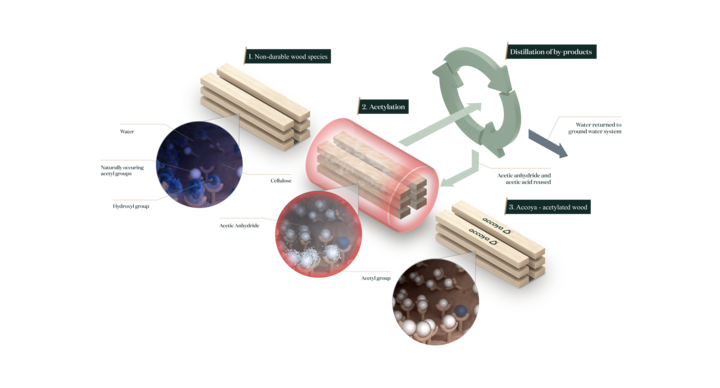
Accsys has focused on closing this performance gap through its proprietary acetylation technology, transforming fast-growing, responsibly sourced FSC®-certified timber (C012330) into high-performance materials with warranties of up to 50 years. Its flagship product, Accoya wood, combines the sustainability benefits of fast-growing timber with the durability and stability often associated with more resource-intensive materials.
Accoya's dimensional stability also contributes to lower maintenance requirements, reducing the resources, emissions and costs associated with frequent maintenance cycles. This focus on extending material life while retaining value has contributed to Accoya achieving Cradle to Cradle Certified® Gold status.
The impact of these performance characteristics can already be seen in major projects across the UK.
On Bristol's SS Great Britain, the world's first iron-hulled, ocean-going passenger liner and now a major heritage attraction, more than 6,000 metres of Accoya decking have been installed as part of an extensive conservation programme. Selected for its resistance to shrinkage and swelling, the material helps protect the historic iron hull beneath while reducing maintenance requirements and supporting the vessel's long-term preservation.
In London, Accoya has also been specified for the façade of Google's King's Cross headquarters, a 300-metre-long 'landscraper' featuring one of the world's largest timber-and-glass façades, fabricated using around 19 truckloads of material. The specification aligns with the project's wider sustainability ambitions, including BREEAM Outstanding and LEED certification targets.
While these landmark projects demonstrate how durable timber can contribute to large-scale sustainable construction, the same principles are equally relevant in homes and heritage buildings across the UK. In applications such as windows and doors, improved dimensional stability can help extend service life and reduce replacement cycles compared with conventional timber alternatives.
However, designing products to last longer is only part of the circular economy challenge. Equally important is ensuring that materials retain value beyond their initial use.
This thinking extends into Accsys' own operations through the Accoya Offcuts Programme, which has been shortlisted for Recycling Project of the Year at the UK Green Business Awards 2026.
Working with wood inevitably generates offcuts, smaller pieces that are often discarded, sent to landfill or directed towards low-value applications. Recognising this as both a challenge and an opportunity, Accsys developed a programme to capture and repurpose these materials, retaining value from manufacturing waste across the value chain.
Through the initiative, Accoya offcuts from joineries and manufacturers are collected, quality checked and sent to Accsys' partner, leading MDF manufacturer Finsa in Spain. There, the material is chipped and transformed into Tricoya, a high-performance wood-based panel product used across a range of applications.
This closed-loop approach extends the useful life of the original material, helping to ensure that the carbon stored within the wood remains locked in for longer while simultaneously reducing waste.
Today, more than 40 UK joineries participate in the scheme. Participants receive collection bags for clean, uncoated material, which are returned to Accsys' site in Barry, Wales once full. Each piece is inspected to ensure it meets strict quality standards, and participating joineries are paid per kilogram collected, providing both a financial incentive and a practical route to reducing waste.
Since its launch, the programme has collected more than 1,000 cubic metres of Accoya offcuts, helping to retain approximately 820 tonnes of CO₂-equivalent within the material lifecycle.
As scrutiny of embodied carbon intensifies, circularity will increasingly be measured not only by what materials are made from, but by how effectively they retain value over time. Increasingly, businesses that can demonstrate resource efficiency, resilient supply chains and practical approaches to carbon reduction are becoming more attractive to investors focused on long-term value creation.
The future of sustainable construction will not be defined by choosing between performance and responsibility. It will depend on materials that deliver both, designed not only to last longer, but to remain valuable throughout multiple stages of their lifecycle.
For the construction sector, circularity is no longer a theoretical ambition. It is increasingly becoming a practical requirement.
Accsys is the sponsor of the ESG Investor of the Year category at the UK Green Business Awards 2026


