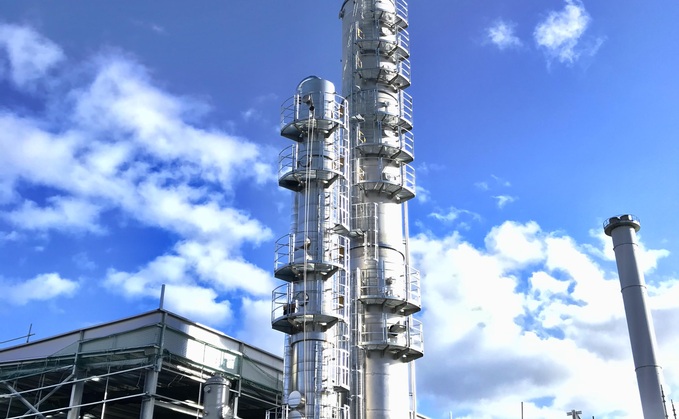
The carbon capture and usage stripper and absorber column | Credit: Tata Chemicals
Government-backed demonstration plant aims to capture tens of thousands of tonnes of CO2 emitted by a power station for use in sodium biocarbonate manufacture
Emissions produced by a power plant in England's North West and now being captured for reuse in the industrial manufacture of sodium bicarbonate, after Tata Chemicals announced this morning that it had opened the UK's largest carbon capture and usage facility to date at a site in Northwich, Cheshire.
The chemicals giant said the demonstration plant would remove 40,000 tonnes of carbon dioxide from the air annually, which would be recycled for use in the manufacturing of sodium bicarbonate, a key ingredient in glass, washing detergents, and pharmaceuticals, as well as in food products, animal feed, and water purification.
Tata Chemicals Europe said the plant marked a major step forward for sustainable manufacturing processes, noting the "pharmaceutical-grade" sodium bicarbonate produced with captured power plant emissions would be "net zero" and have one of the lowest carbon footprints on the market today.
Business Secretary Kwasi Kwarteng touted the facility as a major step forward for industrial decarbonisation efforts in the UK. "This cutting-edge plant, backed by £4.2m of government funding, demonstrates how carbon capture is attracting new private capital into the UK and is boosting new innovation in green technologies," he said. "We are determined to make the UK a world-leader in carbon capture, which will help us reduce emissions and be a key part of the future of British industry."
Meanwhile, Martin Ashcroft, managing director of Tata Chemicals Europe, said the plant was a "great example" of how business and government could collaborate to enable the decarbonisation of heavy industry.
"The completion of the carbon capture and utilisation demonstration plant enables us to reduce our carbon emissions, whilst securing our supply of high purity carbon dioxide, a critical raw material, helping us to grow the export of our pharmaceutical grade products across the world," he said.
Tata Chemicals Europe expects the plant will reduce its carbon emissions by 10 per cent and ensure that it can now generate electricity at its combined heat and power plant with roughly half the amount of carbon dioxide per kilowatt than a typical gas-fired power station.
Ashcroft added that the demonstration project would also showcase the viability of the technology, helping to de-risk potentially larger investments in the future.
"Today marks a key development in our low carbon transition helping to develop more sustainable manufacturing techniques that can be applied at a global level," he said. "It also highlights our commitment to provide long-term, high quality jobs in our local communities which is a key part of our modern industrial strategy as we work towards a net zero economy."
Speaking at the opening of the plant this morning, Mike Amesbury, MP for Weaver Vale said: "The investment made by Tata Chemicals Europe in this leading-edge carbon capture plant will not only support the reduction of carbon dioxide emissions here, but it will also pave the way for others to use this technology," he said. "Tata Chemicals Europe helps support over 1000 jobs so this type of sustainable investment will help secure chemical manufacturing in Cheshire for future generations."
The process used to capture the emissions and reuse them for use in manufacturing, Ecokarb, recently clinched a patent in the UK and has patents pending in other territories around the world, Tata Chemicals said.