The Copenhagen summit entered a critical phase today as the African group of nations hinted that they were willing to scupper the talks, and key players warned that a draft text had to be completed by early tomorrow.
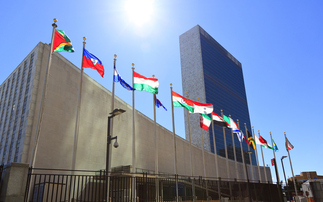
Speaking at the UN headquarters in New York before boarding a plane to Copenhagen, UN secretary general Ban Ki-moon told reporters that diplomats had to have a draft agreement in place before world leaders begin arriving tomorrow.
"There is no time left for posturing or blaming," he said. "If everything is left to leaders to resolve at the last minute, we risk having a weak deal or no deal at all, and this will be a failure of potentially catastrophic consequences."
His comments were echoed by Indian environment minister Jairam Ramesh, who told the Economic Times of India that he would "categorically" demand that an agreed draft text be finalised overnight tonight.
"Ministers and heads of state and government cannot negotiate a text," he said. "The heads of state and government will be arriving from 16 December and they have to work on adopting a political statement."
The looming deadline follows a day of high drama yesterday, which saw the negotiations suspended for five hours after a group of African nations staged a walkout amid accusations that industrialised countries were trying to "kill" the Kyoto Protocol.
The talks resumed in the early evening after UN officials reassured the G77 group of developing countries that negotiations on the Kyoto Protocol would continue. However, in a concerning development, Ethiopian prime minister Meles Zenawi, who will represent 52 African nations at the summit, insisted that the group was willing to "scuttle" the talks.
Speaking at a press conference in Addis Ababa before flying to the Danish capital, Meles said that Africa would not sign up to a deal that did not provide adequate funding to help poor nations cope with climate change and revealed that Chinese premier Wen Jiabao had told him that China would support any boycott.
"If there is no agreement that Africa can sign, I assume there will be no agreement that anybody can sign," he said. "If Copenhagen is simply going to be about an agreement that rides roughshod over Africa, then obviously we'll try to scuttle it."
Meanwhile, the central standoff between China and the US showed few signs of resolution after a senior Chinese official said the government would not submit to US calls for independent verification of China's emissions.
In an interview with the Financial Times, vice foreign minister He Yafei sought to alleviate US concerns that China would demand funding from rich nations, insisting that the country did not expect to take a share from industrialised countries' climate funding commitments.
But he stressed China would verify its own greenhouse gas emissions and resist US calls for independent monitoring mechanisms, arguing that the government's stance was "a matter of principle”.
He also accused industrialised countries of trying to ensure they can blame China if the talks collapse. "China will not be an obstacle [to a deal]. The obstacle now is from developed countries," he said. "I know people will say if there is no deal that China is to blame. This is a trick played by the developed countries. They have to look at their own position and can’t use China as an excuse. That is not fair."
Industrialised nations have generally welcomed voluntary commitments from China and India to cut their carbon intensity, but have insisted that developing countries' climate change strategies must be independently verified if they are to receive funding from richer countries.
"We don't need developing countries to guarantee the outcome of their measures [to cut emissions], but we need the measures to be [verifiable]," one official told the FT.
However, US negotiator Todd Stern sought to downplay both yesterday's walkout and the continuing standoff with China, arguing that such brinkmanship is a standard feature of international diplomacy.
"In any big and complicated negotiation, and this may be the biggest and most complicated ever, it never goes smoothly," he told the New York Times. "It never goes as planned. There are always bumps. There are always zigs and zags, people getting up and down, and that's to be expected."
Deadlock continues over emissions targets, but reports claim gradual progress is being made on climate funding mechanisms 16 Dec 2009
Encouraging moves on climate funding, deforestation and the US climate bill are all overshadowed by increasingly fractious row over future of Kyoto Protocol 17 Dec 2009
Diplomats attempt to calm anger over leaked document, insisting numerous informal texts are being prepared by negotiators 09 Dec 2009
Infrastructure, venture capital, job creation and green financial products should all fall within its remit, say backers 17 Mar 2010
Andrew Williams casts his eye over some of the most popular green driving aids on the market 16 Mar 2010
From hydropower hot spots to record-breaking Texan winds, we run down the top stories from the past week 12 Mar 2010
Few debates cast the UK's business and political community in such an unedifying light as the never-ending row over skills.... 12 Mar 2010