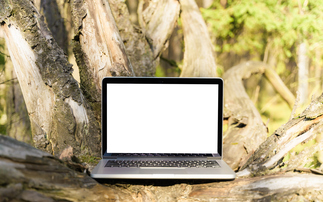
Apple yesterday launched its thinnest ever MacBook laptop amidst claims that the light weight laptop underlined its recent commitments to improve the environmental credentials of its technology.
The company has been heavily criticised in the past year after Greenpeace launched a campaign attacking the manufacturers' use of hazardous components and environmental policies.
Apple boss Steve Jobs responded to the campaign last year pledging to improve the environmental performance of the company's technology and committing to phasing out use of PVC and brominated flame retardants (BFRs) and enhancing recycling rates.
The company has taken the first step towards meeting its new environmental commitments with the launch of the MacBook Air, an ultra-thin laptop boasting a 13.3inch screen, 1.6 GHz or 1.8 GHz Intel Core 2 Duo processor, an 80GB 1.8-inch hard drive and fewer hazardous components than previous models.
Apple said that the laptop incorporated a mercury-free LCD display with arsenic-free glass and used BFR-free material for the majority of circuit boards as well as PVC-free internal cables.
Greenpeace welcomed the launch, heralding it as evidence that its campaign against Apple had proved successful. "This is a massive step," said campaign co-ordinator Zeina Alhajj. "In removing Mercury and Arsenic, Apple is going beyond what is required under the RoHS [restriction on hazardous substances] directive."
Apple said the laptop – which is expected to retail from $1,799 – also meets the Energy Star 4.0 standards for energy use and "consumes the least amount of power than any Mac". Moreover, it is to be sold in a retail box that is 56 per cent smaller than previous packaging, and made from 100 per cent recycled material.
The EcoGeek blog said that Apple had pushed Intel to produce smaller chips for the laptop and consequently other vendors should be able to benefit from the smaller and more energy efficient processors. "You can bet this technology will find its way into Sony, Dell, and HP laptops soon enough," it said.
Tests undertaken by environmental lobby group finds iPhone contains hazardous substances already eradicated by some rival phone manufacturers 15 Oct 2007
Company responds to Greenpeace criticism with statement insisting iPhone meets all legal standards on hazardous substances 16 Oct 2007
Building giant details plans to develop three more commercially viable zero carbon homes over next three years 16 May 2008
Toyota claims the iconic hybrid vehicle has helped cut global carbon emissions by approximately 4.5m tonnes in the last decade 16 May 2008
After two decades of development countless nanotechnologies are fast approaching commercial viability – and they have the potential to redefine the clean tech sector 16 May 2008
Green business courses are springing up think and fast, but as Vanessa Crossgrove Fry warns it could still be several years before we see Green MBAs take their place in the largest firms 14 May 2008