Copenhagen closes with doubts surrounding final accord

As world leaders promise significant action next year, summit ends in angry exchanges and failure to secure unanimous support for final deal

By James Murray

19 Dec 2009

Be the first to comment

Bella Center

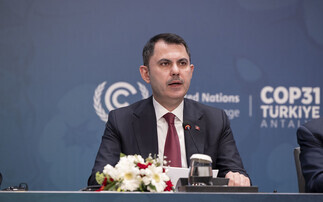
The Copenhagen Summit finally closed this afternoon amid a row over whether the accord agreed by the US, China and other emerging economies overnight should be formally adopted.

After hours of wrangling, the meeting closed with a motion that took note of the accord, but stopped short of formally adopting it.

At 1426 GMT, the chairman of the plenary session of the UN Framework Convention on Climate Change (UNFCCC) bought the gavel down on the summit, declaring that
"the conference decides to take note of the Copenhagen Accord of December 18, 2009".

There was far from unanimous support for the deal, with many poorer nations furious at the manner in which it had been negotiated in private, the absence of emission targets, the vagueness of funding commitments, and the goal of limiting temperature rises to two degrees rather than the 1.5 degrees they had been campaigning for.

Eventually, the African Union and the Alliance of Small Island States joined with industrialised nations and the large emerging economies of China, India, Brazil and South Africa in urging delegates to accept the accord. But a number of countries, led by Venezuela, Sudan and Nicaragua, continued to express vehement opposition to the proposals.

With emotions running high, Lumumba Di-Aping, the Sudanese chair of the G77 group of 130 poor countries, caused outrage when he compared the deal to the Holocaust. "[This] is asking Africa to sign a suicide pact, an incineration pact in order to maintain the economic dependence of a few countries," he said. " It's a solution based on values that funnelled six million people in Europe into furnaces."

His comments brought a furious response from British Energy and Climate Change Secretary Ed Miliband, who labelled the comparison "disgusting".

Visibly angry, Miliband prompted applause when he told the summit: "This is a document produced in good faith that is by no means perfect but which will improve the lives of millions of people. The other choice is what ambassador Lumumba offers us. It is a choice of disgusting comparisons to the holocaust and of wrecking this conference. What will the world think of us if we come out after two years with simply an information document?"

There were also reports that during the final session a Venezuelan delegate cut her palm, protesting that poorer nations had to bleed to be heard by the summit. "You are witnessing a coup d'etat against the UN," she said.

UN Secretary General Ban Ki-Moon accepted that the deal fell well short of expectations, but insisted that it represented an "essential beginning" towards a legally binding agreement.

Attention will now turn to next year when individual countries will have to decide whether to sign up to the accord.

In a development that is likely to spark further controversy, the BBC reported that there could be a list of those countries that back the agreement and those that are opposed to it on the front of the final document, raising speculation that access to the climate funding promised to poorer nations in the deal will only be granted to those that sign up.

The final document dropped an earlier commitment to deliver a legally binding agreement before the end of next year, but world leaders insisted that they were aiming to finalise a treaty during 2010 and that they expected negotiations to now accelerate.

The final text also stated that, "parties commit to implement individually or jointly the quantified economy-wide emissions targets for 2020 as listed in appendix 1 before 1 February 2010" - signalling that a flurry of national emissions targets and climate change strategies will be formally adopted in the New Year.

In addition, the accord paves the way for negotiators to work on individual detailed agreements on specific areas, such as forests, technology, and climate funding. There were also reports that German Chancellor Angela Merkel is already preparing to host a summit on the contentious issue of how to verify countries' efforts to curb greenhouse gas emissions.

WHAT DO YOU THINK? Add your comment


Greg Barker has said that despite cuts to solar incentives the industry will continue to grow this year - is he right?

9%

6%

8%

77%

INSIGHT

Submit your email address and we'll send a link to a personal newsletter control panel


Mechanical Integrity Engineer

09 Feb 2012

Mechanical Integrity Engineer, 35,000-45,000, Midlands A global power organization are looking to identify a Mechanical Integrity Engineer to become part of a globally accalimed engineer department. Delivering R&D Projects in relation to the business' GAS and Steam Turbine operations - the role will challenge the engineers mechanical design capabilities and integrity of company products. The succe

APC

Guidelines for specification of data centre power density

The science and practical application of an improved method for the specification of power and cooling infrastructure for data centres

Quocirca

Powering the data centre

A look at alternative approaches to managing energy for cost and/or sustainability reasons in data centres