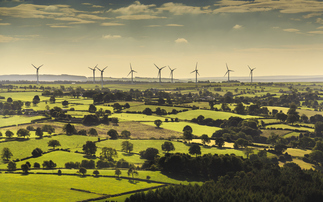
Three out of four onshore wind farms blocked

New figures reveal that while the industry is still growing fast, only 25 per cent of planning applications for onshore wind farms gain approval

By James Murray

21 Oct 2009

Be the first to comment

Wind farm

The UK wind industry was torn between celebration and commiseration at its annual conference this week after new figures revealed that while the sector now has 4GW of capacity, a record number of planning applications for onshore wind farms are being blocked.

The British Wind Energy Association's (BWEA) State of the Industry Report revealed that approval rates for onshore wind farms have sunk to a historic low of just 25 per cent, down from a high of 63 per cent in 2007.

Some anti-wind farm groups have suggested that it is inevitable that approval rates for new onshore wind farms will fall over time as the most suitable sites become occupied. However, the BWEA report revealed that approval rates at appeal for onshore wind farms are running at 62 per cent, more than twice the rate achieved by the local councils that block wind farm planning applications. The group said the high rate of success at appeal confirmed that "many of the fears raised at council level were unjustified".

"The planning system is broken when it comes to wind energy," said Maria McCaffery MBE, chief executive at BWEA. "A 25 per cent approval rate is truly shocking, especially when you think that there is an approval rate of more than 70 per cent for roads, housing and supermarkets."

She added that the high rate of rejection for planning applications was " second best for everyone", arguing that it is both "expensive, slow and cumbersome for developers and frustrating and confusing for local people".

The new figures come as a political row broke out after Conservative front bencher Ken Clark signalled that he was opposed to onshore wind farms, further fuelling accusations that with Tory-controlled councils rejecting more than 60 per cent of wind farm applications, the party is opposed to the expansion of the sector.

In an interview with the Financial Times, the shadow business sec retary said that in his opinion "those few wild and open spaces that we have left in Britain should not be used for wind turbines".

The comments prompted a heated response from energy and climate change secretary Ed Miliband, who accused the Conservatives of failing to match their environmental rhetoric with adequate support for the renewables industry.

"From being photographed cycling to work while being followed by his car, to sticking a wind turbine on his house, David Cameron's environmental spin has no substance," he said. "Ken Clarke's comments today have just blown yet another huge hole in the Tories' green credentials. Once again, we see the reality that Tory green rhetoric is not matched by a willingness to take the tough action needed."

However, despite the ongoing row over planning legislation, there were also signs that the wind energy industry is still expanding fast, after the BWEA reported that 1GW of capacity has been added in the past year, taking the sector's total capacity past the 4GW mark.

The organisation said that wind turbines now provide energy equivalent to that used by all the households in Scotland and predicted that a further 2GW will come online next year.

"The delivery of the fourth gigawatt of wind energy, in the teeth of the UK's worst recession in a generation, is an indication of the maturity and resilience of our sector," said Adam Bruce, BWEA chairman. "Taken together with the 9GW of projects that have planning consent, or that are already in construction, the wind sector is almost halfway to delivering its share of the 2020 targets. "

Meanwhile, on the other side of the Atlantic the American Wind Energy Association (AWEA) reported yesterday that the sector exceeded expectations during the third quarter of the year, installing 1,649MW of new power-generating capacity and taking total new capacity for the year to more than 5,800MW.

The group said the performance marked a significant improvement on the second quarter of the year and was primarily driven by the availability of US economic stimulus funding. However, it warned that increased installations were not being matched by commensurate manufacturing capacity, with US turbine manufacturing still lagging behind 2008 levels.

"Wind power installations are up, and that is good news for America's economy, environment, and energy security," said AWEA chief executive Denise Bode. "But manufacturing, which has the potential to employ many more Americans in good, clean energy jobs, remains uncertain. A firm, long-term national commitment to renewable energy is still needed for the US to become a wind turbine manufacturing powerhouse and create hundreds of thousands of jobs."

WHAT DO YOU THINK? Add your comment


Greg Barker has said that despite cuts to solar incentives the industry will continue to grow this year - is he right?

8%

7%

9%

76%

INSIGHT

Submit your email address and we'll send a link to a personal newsletter control panel


Mechanical Integrity Engineer

09 Feb 2012

Mechanical Integrity Engineer, 35,000-45,000, Midlands A global power organization are looking to identify a Mechanical Integrity Engineer to become part of a globally accalimed engineer department. Delivering R&D Projects in relation to the business' GAS and Steam Turbine operations - the role will challenge the engineers mechanical design capabilities and integrity of company products. The succe

APC

Guidelines for specification of data centre power density

The science and practical application of an improved method for the specification of power and cooling infrastructure for data centres

Quocirca

Powering the data centre

A look at alternative approaches to managing energy for cost and/or sustainability reasons in data centres