Pessimism and deadlock dominate as Bonn climate talks kick off

UN's top climate change official warns negotiators are running out of time to resolve rows over targets and clean tech financing

By James Murray

11 Aug 2009

Comments: 2

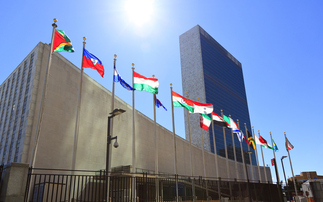
UN HQ

The latest round of UN climate change talks kicked off in Bonn, Germany today, as UN officials voiced growing pessimism that the negotiations to agree a successor to the Kyoto Treaty at a meeting in Copenhagen later this year are falling dangerously behind schedule.

Speaking at the opening of the five days of informal talks, the UN's top climate official Yvo de Boer told BBC News he was increasingly worried that with many of the major emitters remaining at loggerheads the negotiating process was not moving fast enough.

"We have a 200-plus-page text riddled with square brackets [where issues are unresolved]," he said. "And it worries me to think how on earth we're going to whittle that down to meaningful language with just five weeks of negotiating time left."

There are now 117 days until the start of the Copenhagen conference in December where a successor to Kyoto is expected to be agreed. The latest round of talks involving more than 1,000 delegates from about 180 nations are to focus entirely on the development of a draft text for negotiation at the Copenhagen talks.

But de Boer warned that talks surrounding many of the key issues such as emissions targets and financing for clean technologies in the developing world remain deadlocked. "You're looking at hugely divergent interests, very little time remaining, a complicated document on the table and still a lot of progress to be made on some very important issues such as finance," he told the BBC, adopting a more pessimistic tone than at previous meetings.

His comments came as negotiators from China, India and other developing nations again reiterated that they would not sign up to emission targets unless developed nations agree to cut emissions 40 per cent by 2020 based on 1990 levels and increase the sums on offer to accelerate the rollout of low-carbon technologies in the developing world.

These demands appear increasingly unlikely to be met, with the EU committing to cuts of no more than 30 per cent by 2020, and then only if other developed nations agree to similar targets, and the US climate change bill featuring emission targets that require just a four per cent cut in emissions on 1990 levels by 2020. Moreover, US negotiators said they will not sign up to any deal unless all large emitters, including China and India, are on board.

However, Ambassador Chandrashekhar Dasgupta, the senior Indian negotiator, told the BBC that the country did not accept that it qualified as a large emitter given its low emissions per capita. "[India] is a country where half the rural population does not have a light bulb in its home, or a gas ring," he said. "So to describe this country as a large emitter is absurd – there's no other word for it."

In related news, former UK deputy prime minister John Prescott, who was involved in the negotiation of the original Kyoto deal, warned that the Copenhagen talks would collapse unless rich nations shift their position and show greater support for targets based on per capita emissions.

"For a deal to work, it has to have a formula that has an element of equity and social justice in it that reflects the state of each country's industrial development and its emissions per capita," he told the Guardian.

He also said that the West would have to provide much of the funding required to decarbonise developing economies. "The West is going to come up with big money on how to finance alternative energy in the developing countries, including clean coal," he said. "China and India are going to want to know how many billions the rich countries are going to put aside to help them make their carbon contributions. That will be one of the big tests at Copenhagen. The fact is that the West has poisoned the world and left continents such as Africa in poverty. The West will have up to stump up the cash for clean technology."

His comments come as UN secretary general Ban Ki-moon warned yesterday that the world was risking catastrophe if it failed to deliver a robust deal in Copenhagen.

"If we fail to act, climate change will intensify droughts, floods and other natural disasters," he said at an environmental forum near Seoul, South Korea. "Water shortages will affect hundreds of millions of people. Malnutrition will engulf large parts of the developing world. Tensions will worsen. Social unrest – even violence – could follow."

WHAT DO YOU THINK? Add your comment


Greg Barker has said that despite cuts to solar incentives the industry will continue to grow this year - is he right?

2%

5%

8%

85%

INSIGHT

Submit your email address and we'll send a link to a personal newsletter control panel


Mechanical Integrity Engineer

09 Feb 2012

Mechanical Integrity Engineer, 35,000-45,000, Midlands A global power organization are looking to identify a Mechanical Integrity Engineer to become part of a globally accalimed engineer department. Delivering R&D Projects in relation to the business' GAS and Steam Turbine operations - the role will challenge the engineers mechanical design capabilities and integrity of company products. The succe

APC

Guidelines for specification of data centre power density

The science and practical application of an improved method for the specification of power and cooling infrastructure for data centres

Quocirca

Powering the data centre

A look at alternative approaches to managing energy for cost and/or sustainability reasons in data centres