Obama and Hu pledge to tackle climate change, but remain vague on details

Observers likely to be left cold, as addresses to UN fail to deliver detailed new proposals on how to break Copenhagen deadlock

By James Murray

22 Sep 2009

Be the first to comment

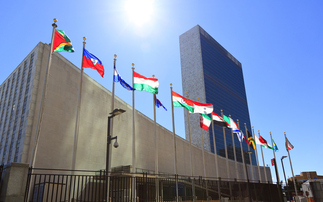
UN HQ

Optimism that today's meeting of the UN could serve to reinvigorate the stalled Copenhagen negotiations appeared to be receding tonight, after US president Barack Obama and Chinese president Hu Jintao both delivered speeches that underscored the seriousness of the climate change threat but failed to deliver the detailed commitments many observers believe are necessary to break the deadlocked talks.

In his address to the UN General Assembly, Hu did announce new initiatives designed to help drive forward the Copenhagen negotiations to agree a successor to the Kyoto Treaty, including a pledge that the Chinese government would for the first time set a target for reducing the carbon intensity of the country's economy by a "notable margin" by 2020.

However, with just over two months to go to the start of the Copenhagen meeting where a deal is expected to be agreed, he failed to set a figure for that target. Meanwhile, speculation that he would announce a date at which China's carbon emissions would begin to fall and unveil plans for voluntary carbon trading schemes within China proved unfounded.

His speech followed President Obama's address, during which he warned the world was at risk of "consigning future generations to an irreversible catastrophe" and pledged that the US would help lead the development of low carbon technologies.

"I am proud to say that the United States has done more to promote clean energy and reduce carbon pollution in the last eight months than at any other time in our history," he said, adding that the government had already authorised billions of dollars of investment in low carbon technologies.

He went on to highlight the fact that the Senate was in the process of debating a climate change bill that would set binding emissions targets, but with that bill still facing fierce opposition he failed to announce the kind of ambitious emission cuts poorer nations have been calling for.

He also reiterated the long-standing US view that large emitters from the developing world, such as China and India, must "commit to strong measures at home and agree to stand behind those commitments just as the developed nations must stand behind their own". Although he then offered an olive branch to poorer countries, acknowledging that the rich world has "a responsibility to provide the financial and technical assistance needed to help these nations adapt to the impacts of climate change and pursue low-carbon development".

There was also marginally more encouraging signs from Japan and Europe, after recently re-elected Japanese prime minister Yukio Hatoyama reiterated his commitment to cut emissions 25 per cent on 1990 levels by 2030 and French President Nicolas Sarkozy proposed an additional meeting of the world's largest emitters in November as part of the increasingly last ditch efforts to agree a deal.

Attention will now turn to this week's behind the scenes talks where it is hoped leaders will start to thrash out more detailed commitments to back up the vague pledges to cut emissions and provide increased funding for low carbon technologies.

The high level talks are expected to continue at this week's meeting of the G20 in Pittsburgh, where Obama said he would work to "phase out fossil fuel subsidies so that we can better address our climate challenge".

The pledge marks something of a breakthrough for climate change campaigners who have long argued that the scrapping of subsidies for carbon intensive industries would represent one of the easiest ways of accelerating the transition to a low carbon economy.

However, on the whole the speeches to the UN are likely to leave environmentalists and green business leaders underwhelmed after a week in which anticipation has been mounting that the meeting could serve to galvanise the stalled Copenhagen talks.

Ban Ki-moon opened today's meeting with a stark warning that the current pace of negotiations was too slow. He added that "failure to reach broad agreement in Copenhagen would be morally inexcusable, economically short-sighted and politically unwise".

WHAT DO YOU THINK? Add your comment


Greg Barker has said that despite cuts to solar incentives the industry will continue to grow this year - is he right?

4%

7%

8%

81%

INSIGHT

Submit your email address and we'll send a link to a personal newsletter control panel


Mechanical Integrity Engineer

09 Feb 2012

Mechanical Integrity Engineer, 35,000-45,000, Midlands A global power organization are looking to identify a Mechanical Integrity Engineer to become part of a globally accalimed engineer department. Delivering R&D Projects in relation to the business' GAS and Steam Turbine operations - the role will challenge the engineers mechanical design capabilities and integrity of company products. The succe

APC

Guidelines for specification of data centre power density

The science and practical application of an improved method for the specification of power and cooling infrastructure for data centres

Quocirca

Powering the data centre

A look at alternative approaches to managing energy for cost and/or sustainability reasons in data centres