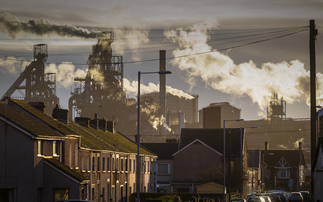
Steel giant Corus has tightened its 2010 energy use target after the company confirmed it was on track to complete a £60m upgrade of its Port Talbot plant before the end of the year that should see the company single-handedly ensure Wales meets its national emission reduction target.
The company is to complete work on a new gas recovery system at the system by October that will allow it to capture gas that is currently flared and reuse it to power the plant. The project is estimated to cut CO2 emissions from the plant by 300,000 tonnes and reduce Corus' global carbon footprint by one per cent.
Speaking to BusinessGreen.com, Dr Paul Brooks, director of environment and climate change at the company, said the project had allowed the board to significantly upgrade its energy use target.
"We had a target to reduce energy use by 11.5 per cent," he said. "But we are now on track to far exceed that and have just renegotiated the target to aim for a reduction of about 16.5 per cent."
The Port Talbot upgrade is the latest step in a company-wide programme designed to cut carbon emissions per tonne of steel produced by 20 per cent by 2020 and by at least 50 per cent by 2050.
Brooks said that Corus currently emits 1.85 tonnes of CO2 for each tonne of steel it produces and is on track to cut emissions to 1.5 tonnes per tonne of steel by 2020 by rolling out energy efficient technologies such as that being installed at Port Talbot across the company's operations.
However, he admitted that to reach the longer term 2050 target the whole industry will have to develop "new ways of manufacturing steel", and to that end Corus is participating in an EU-backed R&D project to identify new Ultra-Low Carbon Steel (ULCOS) manufacturing techniques.
As part of the project, the firm is currently weighing up potential sites in Yorkshire, Teeside and Rotterdam to demonstrate carbon capture and storage technologies.
"There are several different proposals for making low carbon steel, but the one that is closest to commercialisation is Top Gas Recycling Blast Furnaces, where you separate the CO2 and CO from the past furnace, feed the CO back into the furnace and capture the CO2 for storage," Brooks explained, adding that pilot scale separation of CO2 has already been successfully undertaken.
"We are now moving on to the pilot stage and are talking to a number of consortia about potential demonstration projects that we would hope to have online by 2013," he said.
Brooks rejected suggestions that the global recession and low price of carbon allowances within the EU emissions trading scheme (ETS) would derail such investments, arguing that they still made long term financial sense.
He said that while falling production levels meant Corus was currently selling carbon allowances that it no longer needed the company was making investments based on predictions that the carbon price would recover and continue to rise during the next phase of the ETS from 2013.
"You've got to remember the carbon price is only part of the driver behind low carbon investments," added Brooks. "Energy costs and concerns about security of energy supply also play into the business case."
In addition to cutting its own carbon emissions, Corus is also working to develop products that allow customers to reduce their carbon footprint.
Brooks said that the company was currently investing heavily in developing advanced high strength steels for the car industry designed to help manufacturers reduce the weight of vehicles, and was also co-funding a project alongside the Welsh Assembly to develop "solar paint" for use on steel building materials.
Brooks said the dye sensitised paint worked using the same principle as photosynthesis and that early lab tests had proved encouraging.
"The solar paint works at very low efficiencies, but that is not a huge concern when you think that it could be used to cover very large surface areas, " he said. "It is currently being deployed at a lab scale and we will be moving up to pilot scale soon. The coating is only microns thick so using it at mass production scale will be a challenge, but the early results have been great."
Chair of Committee on Climate Change advises government to ignore emission cuts related to recession and aim to beat short-term carbon targets 27 Oct 2009
Energy firms predict further increases in carbon price are imminent if phase three allowances are not auctioned earlier 04 Dec 2009
Cameron presents pre-election energy policy, promising greater investment certainty for low-carbon projects, green loans for households, and streamlining of planning system 19 Mar 2010
Joint statement from carbon exchange and Hungarian government aims to restore confidence in CER market 19 Mar 2010
From climate change contrarians to the "KitKatastrophe" of Nestle's palm oil policy, we look at the best the green web has to offer this week 19 Mar 2010
From the government's plans for a marine energy revolution to John Lewis' proposals for an off-grid supermarket 19 Mar 2010