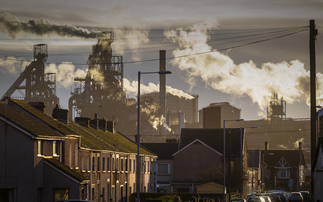
Scientists believe CO2 removed from smokestack emissions could not only cut carbon emissions, but become a valuable raw material for the production of polycarbonate plastics used to make CDs and DVDs.
Two independent studies released this week at the American Chemical Society’s (ACS) national meeting in New Orleans described how polycarbonate plastics could be produced from CO2, raising the prospect of cheaper and more environmentally sustainable plastic products such as CDs, DVDs, lenses and bottles.
Professor Thomas Müller, an academic at Germany's RWTH Aachen University which is working with industrial giant Bayer on carbon capture research, said that it was possible to use captured CO2 as the starting point for the production of polycarbonate plastics.
He said that "new methodologies for activation of the chemically very inert molecule" would need to be developed to enable the carbon dioxide based synthesis of polycarbonates, but added that the plastic would represent an " intriguing sink" for captured CO2.
"Using CO2 to create polycarbonates might not solve the total carbon dioxide problem, but it could be a significant contribution," he said, adding that the development of plastic consumer products that also served as carbon sinks was just "a matter of a few years" away.
He also predicted that there would be a strong economic case for the adoption of such plastic production processes as CO2 would prove a cheaper raw material than current alternatives.
In a separate report, chemists from Japan also claimed they had used CO2 as an alternative feedstock to change carbonates and urethanes into plastics as well as battery components.
Most carbon capture projects are currently focusing on storing CO2 underground, but growing numbers of research projects are now investigating if the gas could instead be re-used in various chemical processes.
Earlier this year, UK start up Carbon 8 Systems announced it had developed a process for using captured CO2 in a chemical process designed to treat hazardous waste and create aggregate materials used by the construction industry.
Researchers at Newcastle University develop catalyst designed to turn carbon emissions into cyclic carbonates used in paint stripper, solvents and plastic bags 29 Apr 2008
Printing manufacturer is investigating whether European firms will be interested in printer that uses reusable plastic paper 22 May 2007
German scientists have succeeded in analysing satellite data to measure European CO2 levels 26 Mar 2008
Building giant details plans to develop three more commercially viable zero carbon homes over next three years 16 May 2008
Toyota claims the iconic hybrid vehicle has helped cut global carbon emissions by approximately 4.5m tonnes in the last decade 16 May 2008
After two decades of development countless nanotechnologies are fast approaching commercial viability – and they have the potential to redefine the clean tech sector 16 May 2008
Green business courses are springing up think and fast, but as Vanessa Crossgrove Fry warns it could still be several years before we see Green MBAs take their place in the largest firms 14 May 2008