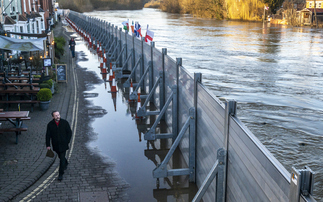
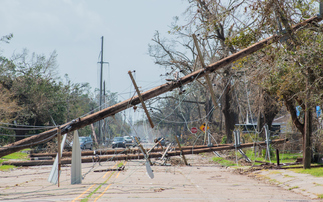
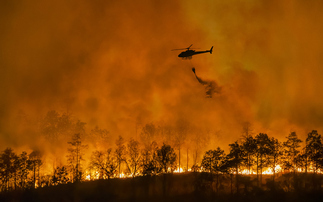
Cranfield University has this week launched a major new research programme designed to help businesses and policymakers meet the challenges posed by increasingly frequent extreme weather conditions.
The £1.6m Community Resilience to Extreme Weather (CREW) initiative is to be funded by the Engineering and Physical Sciences Research Council and will aim to develop a toolkit to help firms and public sector bodies improve resilience to extreme weather events such as floods, heat waves and storms, that are expected to become more frequent as a result of climate change.
The project, which is inviting contributions from businesses and other end users of the toolkit, will bring together researchers from 14 universities and will focus on modelling extreme weather scenarios and devising strategies for limiting the associated costs and business risks.
Initially the project is to focus on the impact on London of the increased likelihood of heat waves, drought, storms and subsidence between 2010 and 2080 and will model a wide range of economic and social impacts, including possible effects on unemployment, house prices and crime. It will also assess how the uptake of coping measures, such as household flood defences and building cooling systems, can be best implemented.
Dr. Gavin Wood, from the Natural Resources Department at Cranfield University, said that in the wake of last summer's floods in the UK there was a growing realisation that extreme weather events represent an increasingly serious social and economic risk.
He said that the project would look at a wide variety of potential risk mitigation strategies, ranging from "adapting social norms, such as taking siestas if Britain gets warmer, to full-blown engineering solutions like redesigning whole cities".
The university said that resources developed by the project would be made available online and urged interested parties to contribute to the research.
Report urges firms to not just focus on cutting carbon emissions and begin adapting to climate change risks 21 Apr 2008
New report claims $35tr of assets will be at risk from coastal floods by 2070 unless businesses and governments embrace "smarter development" 05 Dec 2007
Defence think tank argues tenfold increase in clean tech research spending is required to head off huge new security risks 23 Apr 2008
Climate change monitoring satellite could warn businesses of flooding and aid insurance industry risk calculations, yet the government is flip-flopping on the EU initiative 09 Nov 2007
Drax unveils plans for 400MW co-firing facility that would allow it to burn biomass alongside coal at its giant power plant 22 May 2008
As San Francisco enacts the US's first carbon tax, institutional investors call on the Senate to support binding emission cuts of up to 90 per cent by 2050 22 May 2008
House of Representatives votes in favour of extending renewables tax credits, but fears remain that incentives will be allowed to lapse 22 May 2008
Fresh from the acquisition of lighting specialist LPBV, Lighting Science boss Govi Rao explains how the expanded company plans to combat the supply constraints dogging the LED market 22 May 2008
With industrial plants wasting a huge chunk of the energy they generate through heat, scientists are exploring some wild and wacky ways of harnessing that lost power 21 May 2008
Firms may have woken up to the need to tackle global warming, but when it comes to adapting to its impacts too many remain fast asleep to both the risks and opportunities 20 May 2008