America, where the streets are paved with solar panels

US start up secures $100,000 in government funding to develop prototype solar panel for paving roads and parking lots

By Danny Bradbury

03 Sep 2009

Be the first to comment

Solar Roadway

An innovative project that could revolutionise America's roads has received $100,000 (£61,400) in funding from the US Department of Transportation.

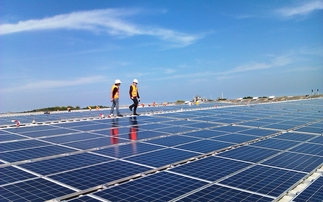
Idaho-based start up Solar Roadways aims to produce parking lots and roads paved with solar panels that could generate almost enough energy to power the entire world, according to the husband and wife team that have developed the concept.

Using a self-cleaning glass system, textured to provide the necessary grip for vehicle tyres, Solar Roadways hope to produce almost five million kW hours of electricity per year for every mile of four-line road covered.

The company said that the panels, which would operate at 15 per cent efficiency, will act as storage devices, holding energy produced by other panels in the roadway grid, and feeding it through to businesses and residences in the area. It added that in addition the panels could help power a nationwide electric car recharging network, making it relatively easy for cars to recharge at the roadside or in parking lots.

The panels are also able to light up using LED technology, which the company says will enable roads to do everything from providing bottom-tunnel lighting, through to embedded road signals that could be dynamically altered to warn motorists of detours, for example. The company even raises the prospect of embedded sensors in the road, which can detect if wildlife are in the way of oncoming traffic and warn drivers using the LED signs.

Solar Roadways plans to use the $100,000 in new funding to develop a working prototype of the solar road panels that will help it to attract further financing.

It estimates the current cost of covering a highway with asphalt at $16 per square foot, and suggests that this covering will last roughly seven years. In contrast, it predicts that its solar panels will boast a lifetime of 21 years, giving a theoretical $48 per square foot cost ceiling under which the idea would become cost competitive.

Until last year, the high price of solar materials, coupled with increased solar demand thanks to government subsidies in European countries like Spain, had made many building or road integrated solar projects appear economically unfeasible.

However, a realignment of policy in key solar markets coupled with plummeting silicon prices has led analysts to predict a steady decline in the price of solar panels over the next few years, with some experts predicting solar power could be cost competitive with coal by 2013. At that point the case for solar roads becomes increasingly compelling, particularly given they could be rolled out over time as roads are upgraded and are unlikely to face the same local opposition that has dogged large-scale renewable energy developments.

WHAT DO YOU THINK? Add your comment


Greg Barker has said that despite cuts to solar incentives the industry will continue to grow this year - is he right?

2%

6%

7%

85%

INSIGHT

Submit your email address and we'll send a link to a personal newsletter control panel


Mechanical Integrity Engineer

09 Feb 2012

Mechanical Integrity Engineer, 35,000-45,000, Midlands A global power organization are looking to identify a Mechanical Integrity Engineer to become part of a globally accalimed engineer department. Delivering R&D Projects in relation to the business' GAS and Steam Turbine operations - the role will challenge the engineers mechanical design capabilities and integrity of company products. The succe

APC

Guidelines for specification of data centre power density

The science and practical application of an improved method for the specification of power and cooling infrastructure for data centres

Quocirca

Powering the data centre

A look at alternative approaches to managing energy for cost and/or sustainability reasons in data centres