Floating wind turbines to be tested off Portugese coast

Portugese utility sees floating platforms as means of cutting high costs of offshore wind farms

By Tom Young

24 Feb 2009

Comments: 1

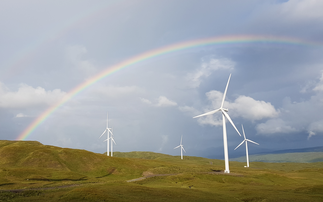
Offshore wind turbine

US-based wind turbine developer Principle Power and Portugal's Energias de Portugal (EDP) have agreed to team up on a project to develop a deep-water offshore wind farm off the coast of Portugal using floating wind turbines.

The development will use Principle Power's WindFloat technology, which sees turbines placed on floating platforms rather than attached to the sea bed. The company argues that the floating turbines are far more cost effective to install in deep water than conventional offshore wind turbines.

The project will be developed in three phases – a demonstration turbine, a pre-commercial deployment and a full commercial deployment – in water more than 50 metres deep.

Antonio Mexia, chief executive of Energias de Portugal, said the technology could provide a major boost to the economic viability of offshore wind farms, which currently cost over double that of onshore developments.

"The development of floating foundations for wind turbines is a pre-requisite to the development of offshore wind farms worldwide, as areas in which the sea bed is less than 50 metres deep are scarce and fixed structures in deeper waters are economically not feasible," he said. "We believe the Windfloat may be the correct approach to deep-water offshore wind farms."

The move is the latest in a seriers of investments from EDP designed to position the company as a major player in the burgeoning global wind energy market. In July, the utility acquired Houston-based Horizon Wind Energy from Goldman Sachs in a €2.15bn deal, and in October followed that deal by shelling out €8.4m for an 85 per cent stake in Romanian wind power companies Renovatio Power and Cernavoda Power.

EDP also holds a stake in the €9m wave-energy Aguçadoura project, which in September installed 2.25MW of wave-energy converters off the Portugese coast.

WHAT DO YOU THINK? Add your comment


Greg Barker has said that despite cuts to solar incentives the industry will continue to grow this year - is he right?

4%

6%

8%

82%

INSIGHT

Submit your email address and we'll send a link to a personal newsletter control panel


Mechanical Integrity Engineer

09 Feb 2012

Mechanical Integrity Engineer, 35,000-45,000, Midlands A global power organization are looking to identify a Mechanical Integrity Engineer to become part of a globally accalimed engineer department. Delivering R&D Projects in relation to the business' GAS and Steam Turbine operations - the role will challenge the engineers mechanical design capabilities and integrity of company products. The succe

APC

Guidelines for specification of data centre power density

The science and practical application of an improved method for the specification of power and cooling infrastructure for data centres

Quocirca

Powering the data centre

A look at alternative approaches to managing energy for cost and/or sustainability reasons in data centres