Investment in clean energy slips, but outlook remains upbeat

Despite quarterly drop in global clean-energy investment, analysts upgrade full-year prediction to between $105bn and $115bn

By Cath Everett

05 Oct 2009

Be the first to comment

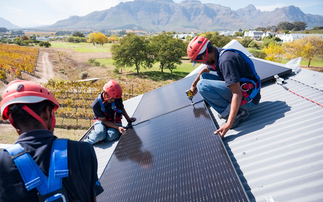
Solar farm

Global investment in the clean-energy sector fell 22 per cent in the third quarter compared with last year's figures as heavy government funding was offset by the continuing limited availability of credit.

Funding levels between July and September dropped to $25.9bn (£16.3bn), down nine per cent on the second quarter but nearly double that of the first quarter, according to London-based New Energy Finance.

The research group said that, despite the third quarter blip, the sector was still showing strong signs of recovery following a poor start to the year. Other industry pundits have also predicted that the situation should look brighter in 2010, although much will depend on the health of the US economy and the financial sector as well as natural gas prices and energy demand.

The clean-energy sector took a hammering in the first quarter of this year after credit markets dried up, natural gas prices fell and demand for electricity dropped. This forced some companies into bankruptcy, while others shelved growth plans and cut jobs.

But Ethan Zindler, who heads New Energy's North American business, said that the industry was now receiving substantially more financial support from governments around the world, which had helped boost investor confidence.

Governments have pledged to spend about $163bn globally on a range of stimulus programmes to promote the adoption of renewable energy over the next few years and, during the third quarter, public market financing rose 45 per cent to $4.5m.

This influx of government funds has prompted New Energy Finance to revise its full-year forecast for investment in the sector from $105bn to $115bn, at the upper end of its previous estimate of $95bn to $115bn.

The report comes just days after two separate studies on the venture capital (VC) market indicated that private equity funding for clean tech firms bounced back strongly during the third quarter as investor confidence returned. One report from the Cleantech Group even suggested that clean tech has now overtaken biotech and IT as the top VC investment category.

In related news, one of the UN's top climate scientists has predicted that clean technologies will become an increasingly attractive investment proposition as governments act to curb carbon emissions.

Speaking at a side meeting at the Governors' Global Climate Summit in Los Angeles, Rajendra Pachauri, chairman of the UN’s Intergovernmental Panel on Climate Change, said that clean technologies represented an increasingly safe bet for investors.

"Investors should be going toward clean technologies," he said. "The world is going to move toward a low-carbon future. That is inevitable."

He highlighted battery technologies, next-generation biofuels and new approaches for producing hydrogen from water as emerging technologies that have huge commercial potential.

He also reiterated his view that people in developed countries should reduce their meat intake as the most effective means of cutting their carbon footprint and advocated wider use of energy efficient light bulbs, rooftop solar panels and more efficient heating systems.

WHAT DO YOU THINK? Add your comment


Greg Barker has said that despite cuts to solar incentives the industry will continue to grow this year - is he right?

4%

7%

7%

82%

INSIGHT

Submit your email address and we'll send a link to a personal newsletter control panel


Mechanical Integrity Engineer

09 Feb 2012

Mechanical Integrity Engineer, 35,000-45,000, Midlands A global power organization are looking to identify a Mechanical Integrity Engineer to become part of a globally accalimed engineer department. Delivering R&D Projects in relation to the business' GAS and Steam Turbine operations - the role will challenge the engineers mechanical design capabilities and integrity of company products. The succe

APC

Guidelines for specification of data centre power density

The science and practical application of an improved method for the specification of power and cooling infrastructure for data centres

Quocirca

Powering the data centre

A look at alternative approaches to managing energy for cost and/or sustainability reasons in data centres