The hidden costs of climate change could cost US businesses hundreds of billions of dollars, slash jobs and kill off niche industries, a new report by the University of Maryland claims.
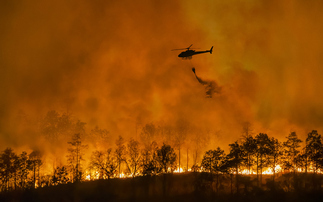
The research, released last week, showed that without swift and targeted government action, the indirect effects of global warming – such as frequent water shortages, natural disasters, pest infections and poor health – would push up prices and severely impact industry.
While the report said it was impossible to put a specific figure on the economic impact, the cost of property damage due to rising sea levels in Alaska alone could hit between $23bn and $170bn by 2100.
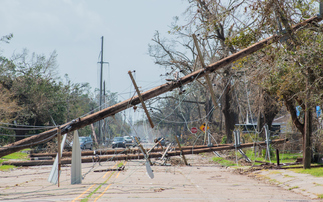
Moreover, it pointed out that while the cost of US storm damage had surpassed $560bn since 1980, more frequent and intense storms caused by pollution would see that figure soar.
"Indirect or secondary economic effects of climate change have rarely been quantified, yet are likely to be substantial", the report entitled The US Economic Impacts of Climate Change and the Costs of Inaction said.
It added: "Increased costs for raw materials, energy and transportation will likely translate into higher prices and a loss of competitiveness that could trigger declines in entire economic sectors or regions."
In particular the report detailed how agricultural firms in New York State
alone may experience a 40 per cent drop in earnings, equivalent to about $1.2bn
in damages.
Meanwhile, water shortages in California could cost companies $6bn a year;
drought in the Midwest region may result in the loss of around 60,000
manufacturing jobs;
and net agricultural income for the San Antonio Texas region is expected to
decline by between 16 and 29 per cent by 2030.
Overall the research concluded that the economic impacts of climate change will occur throughout the country, and while those impacts will be unevenly spread and some positive effects will be enjoyed negative climate impacts will outweigh benefits for most sectors that provide essential goods and services to society.
Lead researcher Matthias Ruth, director of the University of Maryland's Center for Integrative Environmental Research, urged the federal government to implement a national policy for immediate action to tackle greenhouse gas emissions. He also called for more research on a region and sector-specific level to help companies adapt to the effects of climate change.
Presidential hopeful plans to deliver US emissions trading scheme as energy official insists carbon regulations are inevitable 09 Oct 2007
But critics claim government must step up financial support for offshore wind projects if it is to avoid further delays 02 May 2008
Report urges firms to not just focus on cutting carbon emissions and begin adapting to climate change risks 21 Apr 2008
Drax unveils plans for 400MW co-firing facility that would allow it to burn biomass alongside coal at its giant power plant 22 May 2008
As San Francisco enacts the US's first carbon tax, institutional investors call on the Senate to support binding emission cuts of up to 90 per cent by 2050 22 May 2008
House of Representatives votes in favour of extending renewables tax credits, but fears remain that incentives will be allowed to lapse 22 May 2008
Fresh from the acquisition of lighting specialist LPBV, Lighting Science boss Govi Rao explains how the expanded company plans to combat the supply constraints dogging the LED market 22 May 2008
With industrial plants wasting a huge chunk of the energy they generate through heat, scientists are exploring some wild and wacky ways of harnessing that lost power 21 May 2008
Firms may have woken up to the need to tackle global warming, but when it comes to adapting to its impacts too many remain fast asleep to both the risks and opportunities 20 May 2008