I always enjoy visiting the Netherlands. It's a small, prosperous, nicely
designed, concerned and elegant statement of community with the sort of
underlying cultural friskiness that enabled them to become the first
Enlightenment trading empire.
This time it was Delft, and I noticed two things in particular: the continuing
popularity of bicycles, bolstered by an elaborate and effective bicycle
infrastructure, and a concomitant lack of obesity, to which one becomes all too
inured in the United States.
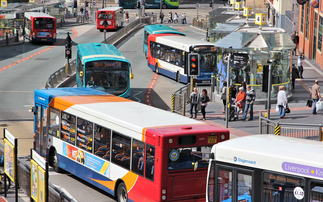
Bicycles and a degree of health are not just related in the obvious way. Both can also be understood as emergent characteristics of engineering design and related policy choices, particularly involving transportation infrastructure.
To oversimplify: in the Netherlands, bicycle infrastructure is given equal standing with automobile infrastructure, resulting in integrated transportation systems that, as a spin-off, produce both environmental and health benefits.
In the United States, we increasingly design infrastructure that actively discourages both walking and bicycle use, either directly (try walking from long term parking lots to the terminal in many US airports), or indirectly (you take your life in your hands if you bicycle along busy streets in many US towns and cities). We're an obese society because we design for it.
One shouldn't, however, romanticise what's going on. The Dutch like their cars, and they don't eschew automobiles where appropriate, or require people to bicycle, or ban fast food outlets.
Their approach is not to force people to give up what they think they want, and thus expiate their sins by suffering, as environmental and public health activists, those modern Calvinists, so often try to do.
Rather, in the best tradition of the free market and a trading society, they create an environment by, for example, building appropriate infrastructure, that offers a choice, unlike in the United States.
In this way, they can increase rather than restrict choice, and thus create a higher quality of life while encouraging other public benefits such as good health (like most jurisdictions, tax and user fees are structured to encourage appropriate behaviour).
More broadly, once one realises that an increasingly important and appropriate goal of engineering is creation of option spaces that allow individuals to enhance their quality-of-life through choice, rather than through mandate, other possibilities open up.
For example, transportation engineers often talk of designing their systems for "activity fulfillment," which enables people to perform the activities they want in as efficient a way as possible.
This concept can be generalised to include "virtual activity fulfillment" through, for example, substitution of information and communication technology (ICT) options for physical transportation.
Thus, young people increasingly substitute social networking on various internet sites for driving to physical spaces such as malls to meet each other, while their working peers substitute virtual offices and network functionality for the traditional rush hour automotive jousting session.
Increasingly, university classes and learned symposiums, board meetings and engineering sessions, or art expositions and innovative concerts are now held in virtual realities rather than requiring cross country or even international travel.
What is significant in all these cases, from Dutch bicycles to Second Life seminars, is that the integrated natural/built/human systems that increasingly characterise our world can be designed in such a way as to provide additional choice to each individual while meeting overarching social goals.
Provision of choice ensures both higher quality of life, and a continuing respect for the individual, concepts that activists occasionally undervalue given their focus on specific issues.
Additional choice may not have the same absolute guarantee of performance as mandates do - many obese Americans will not jump on bikes just because you give them a safe infrastructure, at least at the beginning - but it builds public support for environmental and public health goals in a way that more adversarial and authoritarian approaches cannot. Gains in the short run may be less under a choice regime, but they will be stable and enduring, and lay the groundwork for more rapid and fundamental cultural change than adversarial and scare tactics do.
But first, we have to build those option spaces. For planners and engineers, one lesson seems clear. Think of these systems as we always have in the United States - transportation as roads, rails, and air - and we unintentionally restrict a panoply of benefits.
Think of them as enabling choice and reflecting function, however, and we have the opportunity to enhance both quality of life, and address a whole set of other policy dimensions as well. No wonder I like the Netherlands.
This article first appeared at Climatebiz.com
Building giant details plans to develop three more commercially viable zero carbon homes over next three years 16 May 2008
Toyota claims the iconic hybrid vehicle has helped cut global carbon emissions by approximately 4.5m tonnes in the last decade 16 May 2008
After two decades of development countless nanotechnologies are fast approaching commercial viability – and they have the potential to redefine the clean tech sector 16 May 2008
Green business courses are springing up think and fast, but as Vanessa Crossgrove Fry warns it could still be several years before we see Green MBAs take their place in the largest firms 14 May 2008